
Bursting the "Writing Should Be Inspired" Balloon
Letting Go of the Myth of Inspired Writing to Write More


I was once watching a pilot for a TV show whose protagonist was a professor at Oxford or Cambridge or some other ancient British institution. The show took great pains to establish her at work in her profession (which interestingly, never included teaching). The camera followed her as she poured over old books in a Hogwartsesque library and furiously scribbled away on a legal pad. The library was quiet and filled with other travelers on the road to intellectual breakthrough. She was focused, intent, and immersed in her work and we in the audience could feel her excitement at each new discovery. I felt inspired and I remember thinking, “wow, I want her job.”
Dear reader, it took a laughable amount of time for me to realize that I, in fact, had her job. I was a university professor, a researcher, and a writer; yet the romanticized version of research writing seemed foreign and disconnected from my lived day-to-day. She spent days on end in that library without any distractions (save the immanent peril that eventually found her. Don’t worry, she then turned into Indiana Jones to save the day). I didn’t even recognize this representation of my own profession.
This familiar depiction of life in the academy is alluring for so many of us and that image of the academic is connected to a fundamental myth we tell ourselves about writing. We believe that all writing should be inspired, that it has some ideal conditions that must be met for it to happen, and that if we don’t feel like writing, then it will be impossible. We chase the romance and yearn for our Hogwarts library that will make the writing appear magically on the page.

Photo by Shane Rounce on Unsplash
Not only does this myth make writing illusive, but it sets the bar so high that when we do write, we often judge that writing as uninspired. We spend copious amounts of time editing each sentence as we write because we are still seeking that perfect inspired thought that lands on the page with gusto.
The Painful Truth About Writing
Now I’m here to tell you a painful truth about writing. Brace yourself because it’s going to hurt anyone who has not discovered this already. Don’t be afraid though, by ripping that band aid off, we can start assuaging some of the mental blocks that hinder our writing in the first place.
If you want to write a lot, try thinking of writing as mundane.
Writing is more often uninspired, it rarely takes place in romanticized conditions, and to do it a lot requires the habituation of brushing your teeth. When you sit down to write as a habit, your feelings about it are often neutral and only fueled by the inertia of doing it regularly. The most prolific writers aren’t chasing inspiration, they are seeking the comfort of the routine. They don’t wait till that writing retreat in some exotic location or communion with the right group of scholars to write, because those spaces are elusive and few and far between. Most productive writers stop seeking their Hogwarts library and settle into writing in that cluttered corner of their apartment.

Photo by Khara Woods on Unsplash
Now that your balloon of “writing should be inspired,” is fully burst, I can tell you the good news.
Thinking of writing as something that should be inspired creates unneeded pressure on us that can be alleviated by thinking of it as mundane. When we free ourselves from the myth of inspired writing we can also free ourselves from a major block to getting that writing done. If we just think about our writing as words on the page instead of something magnificent or special, then we produce many more words and spend far less time judging those words.
To be clear, I am not suggesting that we produce bad work, but I’m saying that at the drafting stage in particular, we should let go of the need for inspiration and perfection. Plus, it’s important to keep drafting and editing separate because these are two different parts of our brains: drafting is creative and editing is analytical. Trying to do both at the same time leads to much slower writing, as does constantly waiting for the muse to find us before we start.
Reframing our thinking about writing doesn’t mean that inspired writing never happens, but a curious thing occurs when we abandon the chase of the muse and embrace the habitual nature of the craft. Inspiration finds us more often because we write much more often. We let go of the fervent need for inspiration, then it somehow finds its way to us at unexpected times.
Writing to You from a Beautiful…Construction Site!
Point and case: I’m currently writing from a hotel in sunny Florida. This morning I woke up, had my coffee, packed my laptop, and went down to the hotel pool. I imagined what this was going to look like before I went: a large pool with palm trees, lots of other tropical foliage, and tables with umbrellas where I could sit quietly and write before the rest of the hotel guests arrived. After all, just because I don’t need the perfect conditions to write, doesn’t mean I don’t enjoy a little romance once in a while.
As I found my way to the pool area, cold hard reality sunk in. There is a construction site conveniently located behind the pool and the workers were earlier risers than I was. The hammering, drilling, and beeping of equipment was cacophonous and my view primarily consisted of multi-level apartment buildings under construction. My writer heart sunk.
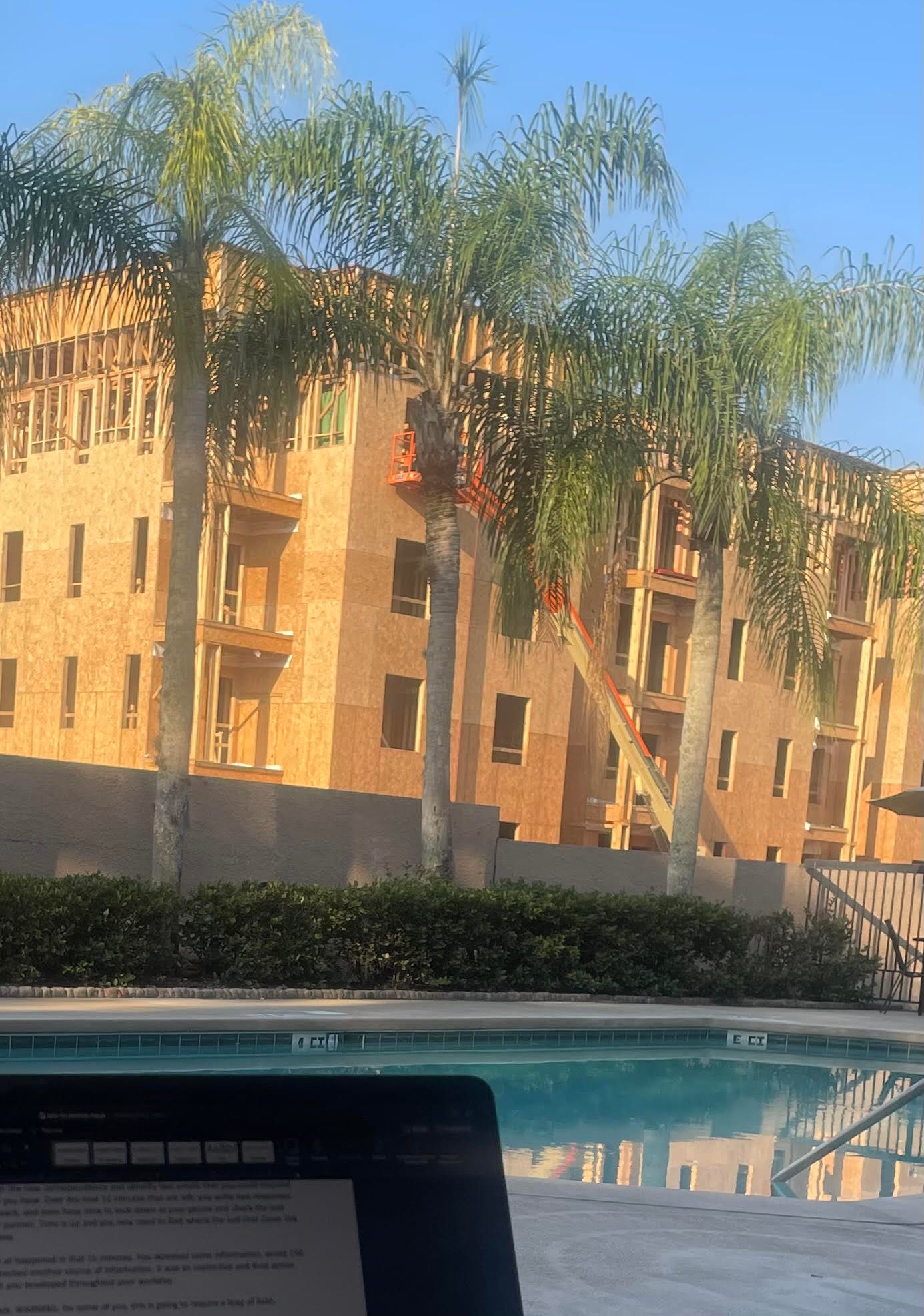
If I required an inspired place to write before I could begin or if I needed the perfect conditions of both the location and my own feelings about writing, then I might have turned around and gone out seeking another venue. Instead, I let go of my preconceived notion of what writing was supposed to look like this morning and instead just sat down and pulled out my laptop.
My piece of actionable advice for you is this: reflect on what it would take for you to begin practicing writing as mundane, as rarely happening in perfect bliss, and as something you feel neutral about instead of something that requires an outpouring of positivity. How can you make it a habit? One suggestion is to carve out spaces in your schedule this week where you sit down, set a timer for whatever time you want, and just write. Tell yourself that all you need is words on the page, that it doesn’t have to be good, it just must be done. Abandon the notion that writing must occur at an ideal time, take place in perfect conditions, or be exceptional.
Even though you’re not seeking inspiration, you’ll be inspired by how much you can write and how well you do so when you take some of the pressure off drafting.
For all of you who felt my disappointment at finding my perfect writing morning smashed by hammers, never fear. I added 1000k words to the page and there were, in fact, palm trees by the pool.